Custom Donut Trays


Trusted by 980+ of the World's Best Organization.


Get an Instant Quote

Free Artwork

Biodegradable & Recyclable

Fastest Turnarround

Renewable Plant Based Material

Free Delivery
Order Custom Donut Trays
Order custom donut trays & boxes with your brand logo. Get the best quality and customized printed donut tray packaging boxes at affordable prices from CustomPrintedPaper.co.uk.
Key Features
|
Why Choose US?
|
Custom Donut Trays: A Complete Guide to Choosing the Right Packaging
Donuts come in many shapes. A plain ring is flat and light. A filled donut is taller. A chocolate donut with sprinkles needs extra room. One standard tray rarely suits all of them. That is why bakeries often choose custom donut trays made around their own products.
This guide explains how to size, build and order custom donut trays for a UK bakery, café or donut shop. You will learn how to measure donuts, compare materials, check food safety and plan printing. You will also see how the order process works, from first quote to final proof.
What Are Custom Donut Trays?
Custom donut trays are made-to-order trays built around the size, quantity and decoration of your donuts. They are usually made from paperboard or cardboard. They can include set compartments, printed artwork, and a fit for outer boxes or lids, so each donut stays separate.
Bakeries, donut shops, cafés, caterers and food startups all use them. Some place donut packaging trays on the shop counter. Others slide them into takeaway boxes or use them for events. Many UK buyers write “doughnut” instead of “donut”, so you will also see custom doughnut trays in searches. Both terms describe the same product.
A tray is open at the top. A box is closed. Many bakeries use both. The tray holds each donut in place, and the box protects the tray on the move. If you need the outer layer, see our custom donut boxes.
Why Use Custom Donut Trays for Bakery Products?
A well-sized tray solves a few daily problems in a bakery.
- Product separation: Each donut sits in its own space, so icing and toppings stay apart.
- Neat presentation: A tray cut to size leaves no loose gaps. Donuts look tidy on the counter.
- Faster handling: Staff can pack, stack and lift trays that always hold the same count.
- Steadier transport: A snug cavity limits sliding on a short trip.
- Brand visibility: Printed bakery trays carry your logo and colours from the counter to the customer’s door.
- Custom capacity: You pick the number of donuts, such as two, four, six or twelve.
How to Choose the Right Donut Tray Size
Sizing is the most important step. A tray that is too tight can crush toppings. A tray that is too loose lets donuts slide. So always measure the finished donut, not only the plain base.
Follow these steps to measure for custom size donut trays:
- Measure the widest diameter of the donut.
- Measure the finished height, including any filling bulge.
- Add the height of toppings, such as sprinkles, nuts or biscuit pieces.
- Decide how many donuts each tray should hold.
- Allow clearance between donuts and at the tray walls.
- Check the inside size of any outer box or lid.
Then use this simple formula: cavity size = donut diameter + decoration width + side clearance. Heavy icing, chocolate pieces and piped decoration need more clearance than a plain glazed ring.
Hand-finished donuts vary a little. Measure several from the same batch. Use the largest one as your guide. Then send those measurements with your quote request, so the tray is built around your real product.
Different donut types affect tray design in different ways:
| Donut type | What to plan for |
| Plain ring | Standard clearance. This is the simplest cavity to plan. |
| Glazed | Glaze is sticky and can mark plain board. Plan for grease resistance and a little extra room. |
| Filled | Height changes with the filling. Measure at the tallest point. |
| Chocolate covered | The coating needs space so it is not rubbed against the walls. |
| Heavily decorated | Wider cavities and more space between donuts. |
| Mini donut | A smaller cavity grid with more cavities per tray. |
Donut Tray Layouts and Capacity
Capacity is not fixed. It depends on donut diameter, decoration and the spacing you choose. A tray that suits plain donuts may not suit decorated ones.
So how many donuts fit in a tray? There is no single standard number. A custom tray is built for the count you choose.
Common layout choices include:
- A single-donut tray for gift sales or premium products
- Two, four, six or twelve cavities, as examples
- Grid layouts that make good use of the board
- Divided compartments for mixed flavours
- Smaller grids for mini donuts
Your own layout can differ from these examples. Share your count and donut sizes, and the tray can be planned around them.
Best Materials for Donut Trays
Most trays use paper-based board. Each option suits a different job:
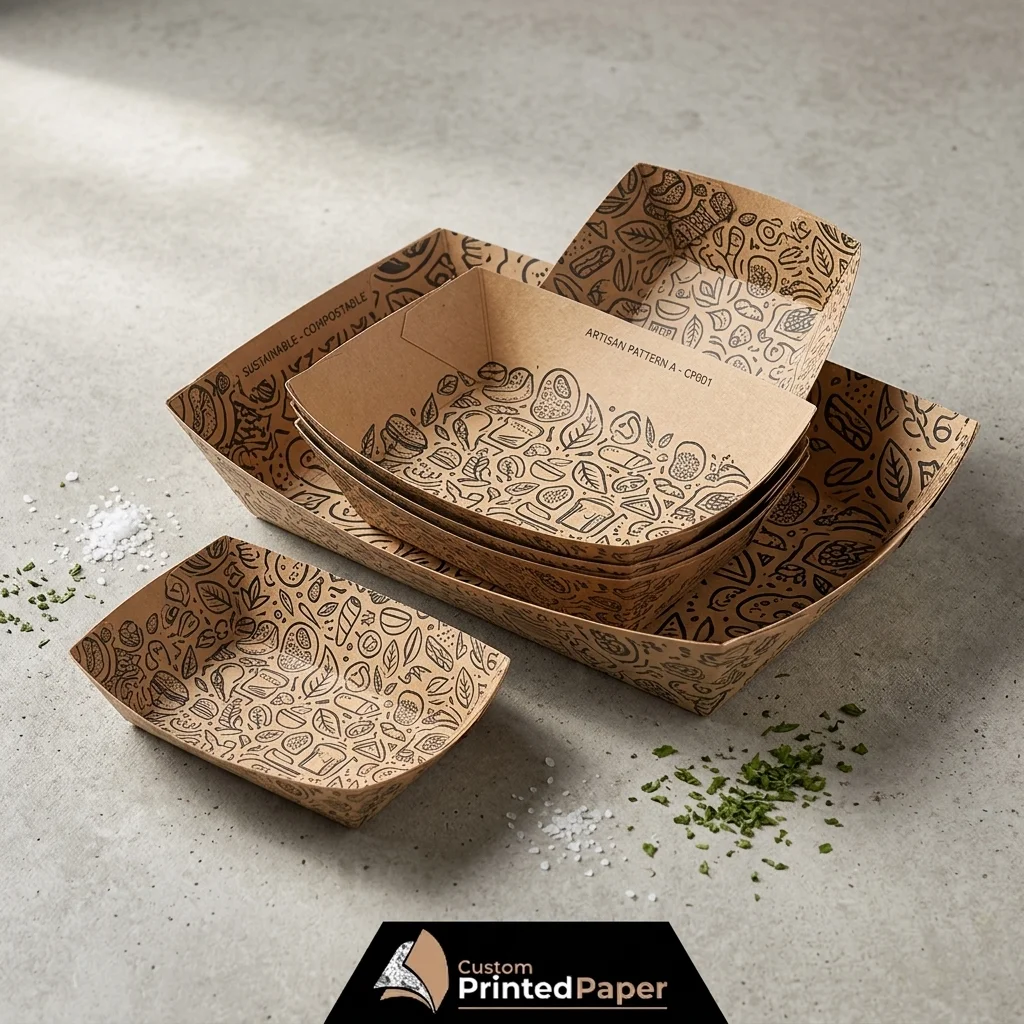
- Paperboard donut trays have a smooth face that prints well. They suit counter display and light use.
- Kraft donut trays have a natural brown look. They suit bakeries with a simple, handmade style. For matching outer packaging, see our custom kraft boxes.
- Cardboard donut trays have a sturdier build. They suit heavier donuts and longer trips.
- Corrugated board adds a fluted layer for strength. It works where stacking or delivery needs extra support.
No single material is best for every bakery. A display tray has different needs from a delivery tray. Tell your supplier how the tray will be used, and choose the board to match.
Food-Safe and Grease-Resistant Donut Trays
Donuts are often oily or sticky. Grease can soak into plain board and leave marks. That is why grease resistant donut trays matter, especially for glazed and filled donuts.
Food safety matters just as much. GOV.UK guidance says food businesses that package food themselves must use packaging suitable for food use. So the board and coating must suit your product.
Before you order food safe donut trays, ask your supplier to:
- Confirm that the board and coating suit direct food contact
- Provide supporting documents for the chosen material
- Confirm the grease resistance level for your donut type
- Explain where any printed ink sits on the tray
A supplier offers the material. You still need to check that it suits your own product and use. The same questions apply when you order custom food boxes or other food packaging.
Custom Printed Donut Trays
Branding turns a plain tray into part of your shop’s identity. Custom printed donut trays can carry:
- Your logo
- Brand colours
- Repeat patterns or illustrations
- Inside and outside printing
- Seasonal artwork for holidays and events
Finish options depend on the board and specification you choose. Confirm them when you request your quote. For a wider view of print options, see our custom printed paperboard packaging.
Keep your artwork simple. A clear logo and two or three brand colours often read better than a crowded pattern. Supply vector files where possible. Then check the proof for logo position, spelling, colours and fold lines before you approve production. Well-planned printed donut trays also help customers recognise your brand when they open the box.
Donut Trays for Display, Takeaway and Delivery
The same tray does not suit every use. Plan around where your donuts will go:
- Display: Choose a tidy, open tray that makes donuts easy to see and reach.
- Takeaway: Measure the inside of your outer box first. The tray must fit with a little room to spare. Takeaway donut trays often pair with custom donut boxes or custom bakery boxes.
- Catering: Choose larger layouts and stable stacking for mixed selections.
- Delivery: Choose stronger board, snug cavities, and a lid or outer box.
Do you also sell cupcakes, cakes or pastries? Matching custom cupcake boxes, custom cake boxes and custom pastry boxes keep your whole range consistent. For other sweet treats, browse our custom dessert boxes. If you need a simple open base for other products, see our custom food trays.
Donut Trays With Dividers, Lids and Windows
Extra features can improve protection and display. Availability depends on the tray design, so confirm each feature when you request a quote.
- Dividers:Donut trays with dividers keep flavours apart and reduce contact between toppings.
- Lids:Donut trays with lids protect the donuts and help with stacking. The lid must clear the tallest topping.
- Windows: A window lets customers see the donuts without opening the pack.
Eco-Friendly Custom Donut Tray Options
Many buyers want eco friendly donut trays. Paperboard and kraft are paper-based, which is a good start. However, avoid blanket claims such as “all paper trays are recyclable”.
Recyclability depends on the board, coatings, construction and local recycling rules. Recycling guidance separates paper and board from fibre-based composite packaging, so the exact build matters.
To choose recyclable donut trays with care:
- Ask how your supplier classes the board and any coating
- Use the lightest coating that still handles grease
- Size the tray close to the donuts to reduce wasted board
- Avoid extra layers you do not need
UK packaging rules are also changing. Extended Producer Responsibility (EPR) shifts the cost of handling household packaging waste toward producers.Lists a business recycling target of 77% for paper, board and fibre-based composite packaging in 2026, rising to 79% in 2027. Check the current guidance to see how it applies to your business.
How Donut Trays Are Made
The process is simple when the details are clear from the start:
- Dimensions: You supply donut size, count and use.
- Dieline: A flat template shows every cut and fold line.
- Artwork: Your logo and colours are placed on the dieline.
- Proof: You check and approve the layout.
- Printing and cutting: The artwork is printed and the shape is die cut.
- Folding: The tray is formed.
- Quality check: The finished trays are checked before dispatch.
How Much Do Custom Donut Trays Cost?
Price depends on your specification, so we do not list one fixed figure. These factors have the biggest effect:
- Size and cavity count: Larger trays use more board.
- Quantity: Higher volumes often lower the cost per tray.
- Material: Kraft, paperboard and corrugated board price differently.
- Printing: More colours and more printed areas add cost.
- Finishing: Coatings and special finishes add steps.
- Structure: Dividers, lids and windows make the design more complex.
- Sampling: A sample adds time and cost before bulk production.
- Delivery: Volume, weight and location all matter.
If you need wholesale donut trays, share your expected volume. Also confirm the minimum order, turnaround time and delivery details when you request your quote.
How to Order Custom Donut Trays
- Choose your quantity.
- Send your donut measurements.
- Select the material.
- Choose printing and finish.
- Submit your artwork.
- Review the proof.
- Approve production.
- Receive your bespoke donut trays.
Accurate measurements save time and reduce changes later. Keep the details precise, and the quote will be easier to match to your needs.
Specifications For Customised Donut Trays
| Box Style | Custom Donut Trays |
| Dimension (L + W + H) | All Custom Sizes & Shapes |
| Quantities | No Minimum Order Required |
| Paper Stock | 10pt to 28pt (60lb to 400lb) Eco-Friendly Kraft, E-flute Corrugated, Bux Board, Cardstock |
| Printing | No Printing, CMYK, CMYK + 1 PMS color, CMYK + 2 PMS colors |
| Finishing | Gloss Lamination, Matte Lamination, Gloss AQ, Gloss UV, Matte UV, Spot UV, Embossing, Foiling |
| Included Options | Die Cutting, Gluing, Scored, Perforation |
| Additional Options | Eco-Friendly, Recycled Boxes, Biodegradable |
| Proof | Flat View, 3D Mock-up, Physical Sampling (On request) |
| Turnaround | 4 – 8 Business Days, RUSH |
| Shipping | FLAT |
What size should custom donut trays be?
Size them around your own donuts, not a standard chart. Measure the finished diameter and height, including toppings. Then decide how many donuts each tray holds and add clearance between them. If the tray goes inside a box, check the inside size of the box too.
Are custom donut trays food safe and grease resistant?
They can be, but it depends on the board and coating you choose. Ask your supplier to confirm that the material suits direct food contact. Also confirm the grease resistance for your donut type, such as glazed or filled. GOV.UK says food packaging must be suitable for food use.
Can custom donut trays be printed with a logo?
Yes. You can print a logo, brand colours, patterns and seasonal artwork on your trays. Finish options depend on the board and specification. You review a proof before production starts, so you can check every detail.

Customized Style

Customized Printing

Competitive Price

Free Shipping

Endless Customisation Available For Donut Trays

Offset Print
If you’re looking for large-volume packaging materials, choose offset printing! This printing method produces clean, crisp, and brilliant results. It uses plates to transfer ink to paper, so it is economical for printing in bulk. The process provides accurate color, professional quality, and an outstanding look and feel, which is ideal for cutting custom box designs.

Digital Print
Digital printing works well for short runs and quick turn times. It doesn’t use printing plates, but instead prints directly from a computer file. It is cheap for small amounts and gives good resolution. It’s ideal for custom designs, variable data or limited edition packaging that requires speed and flexibility.

UV Print
UV printing is a process that uses ultraviolet light to dry and cure the ink as it is printed. It easily operates on traditional and non-traditional materials. This process adds to the visual appeal of such packages, as well as their durability, and packages that require a combination of both texture and shine are perfect candidates for such execution.

Pantone
Pantone printing is based on a standardized color matching system to guarantee an exact color match between jobs. It’s great for keeping brand colors perfect. Pantone ink is mixed using Pantone formula guides developed through spot printing for color accuracy that is reported as second to none. For luxury packaging that demands trustworthy, uniform, and sumptuous color from the start.

C1S
C1S is an acronym for “Coated One Side,” as the paperboard is glossy on one side and uncoated on the reverse. It is wonderful in packaging where you need a printed, high-end, printable side outside, and you may want the inside to be writable or matte. Perfect for handcraft, small business and so on, ideal for packaging boxes, shelves, product tags with a polished look.

C2S
C2S, which stands for “Coated Two Sides”, has a smooth and shiny coating on both sides of the paperboard. This is why it is ideal for stunning full-color printing, regardless of whether you are an individual or a company. Retail packaging, brochures, and cosmetics boxes that require a high-quality, high-gloss finish both inside and out use C2S.

White Kraft
White Kraft is similar to traditional Kraft, but with a printable white surface. It features a crisp white surface that produces sharp and clear prints, making it perfect for high-quality images. This is a material commonly used to manufacture sustainable packaging, which is required to have attractive prints for a professional brand image.

Kraft Paper
Kraft paper is natural brown and unbleached. Thai material is derived from wood pulp and is recyclable. Companies that want to attract eco-conscious consumers prefer Kraft material. It has a rough texture, which is perfect for handcrafted items for a rustic look and protective packaging.

Coated Kraft (CCK)
This paper is brown Kraft with a smooth, white clay-coated surface that enhances the appearance of whatever you print on it. It offers a sleek look that is ideal for graphics, prints and text branding. This hybrid design is perfect for packaging that requires both sustainability and sharp visual branding.

Color Woodfree
Color Woodfree paper has a smooth dyed surface that is free of wood fibres, for a clean finish. It is typically acid-free, and both image and color remain crisp. Ideal for presentation packaging, greeting cards, and custom box lining, where a consistent, solid color and luxurious finish are needed.

CCNB
CCNB (Clay Coated News Backboard) is made from recycled paper and has a clay-coated white backing for printing. The back remains gray or brown, preserving its eco-friendly nature. It is a very cost-effective substrate and is used extensively in folding cartons, retail packaging, and food service boxes, where low printing costs and moderate strength are the primary concerns.

Black Cardboard
Black cardstock is 100% black for a rich look that is both professional and elegant. It’s rigid and robust. It creates exceptional luxury product boxes and helps in premium branding. The materials’ smooth and matte surface is suitable for foil stamping and other premium finishes to add class and quality.

Glossy Lamination
Glossy lamination is used to give a shiny surface to the custom boxes. This coating is also an excellent option to protect the material from scratches. If you want to give your boxes a professional finish and protection from scratches, then gloss lamination is an ideal option. The high quality of the lamination protects the packaging material from moisture and enhances its longevity.

Matte Lamination
The covering is a matte lamination to give a smooth surface with a non-glossy finish, with a premium feeling. It can lower glare and has a soothing quality to particular colors. This finish is frequently used when a modern, subtle appearance is required and a sound, protective barrier is necessary to help resist smudging, light scratching and light abrasion while still offering the look of natural wood grain.

Soft Touch Lamination
The velvet-like feel makes it soft to the touch, lamination and creates an amazing tactile sensation. The surface feels good and is easy to hold. It increases tactile interaction and reinforces a brand message with elegant visuals, yet it is still durable; resists moisture, wear, and. damage during handling.

Anti-scratch Lamination
Anti-scratch lamination resists scratches, prevents scratches, and reduces the visibility of scratches. It holds up better with dust. This finish is also excellent for packaging applications in which the item needs to be kept in prime condition via handling and shipping, and for the retail shelf, where resistance to wear and durability are a must for on-shelf appearance and quality control.

UV Varnishing
UV Varnishing is a high-gloss coating that adds depth and appeal to the printed image. Cured with Ultraviolet light to be hard and ready to use. This process creates a very distinctive, eye-catching appearance and provides additional protection. It also has the added benefit of hiding light scratches, fingerprints and dirt.

Machine Varnishing
Machine varnishing provides the packaging with an even finish that is applied during production. It beautifies your surfaces and lasts up to 15 years. Its finish is consistently good on large runs, and provides for good smoothness, clarity, and slight gloss increase as well as improved resistance to minor wear and dulling over time.

Calendering Varnishing
Varnishing calendering is the process that gives gloss and smoothness with heat and pressure. It also helps to crisp up printed detail and feels more professional. This process enhances details and gives an inviting feel to the printed product for premium quality presentation packaging.

Water-Base finishing
Water-based coating offers a protective and environmentally safe coating that is also strong and long-lasting. It provides a matt/natural or gloss/soft gloss finish effect without being applied using hazardous materials. This option is perfect for companies that value environmental consciousness and are in need of a smooth surface that is reflective as well as protective.

Water Base Ink
Ecologically friendly water-based ink that is non-toxic and gentle on skin. It is suitable for different kinds of printing processes, including superior carton printing quality.

Soy Ink
Soy ink is manufactured with soybeans and is sustainable in nature. This ink has the ability to give vibrant colors and impactful designs that give your custom printed boxes an alluring look. It has a much smaller carbon footprint as compared to petroleum-based inks.

Fluorescent Ink
Fluorescent ink gives designs that glow under UV light and create a catchy design. This ink is ideal for special effects, as well as for producing prints that pop. It is commonly used in posters, labels, signs and other marketing materials which must be read easily in a variety of conditions.

Oil Base Ink
This kind of ink uses petroleum and is becoming popular simply because it is durable and of high-quality color. Exhibiting excellent print resolution and high-standard graphics quality. Oil-based ink gives perfect quality images, especially on porous surfaces that are otherwise hard to print. But it has a greater environmental impact in terms of its chemistry.

Foil Stamping
In foil stamping, heat is used to transfer ink to the surface. You can get matte to gloss and holographic images on your packaging. Foil stamping outshines your packaging among the other brands and gives a high-end look to your product.

Spot UV / Spot Gloss
In spot UV, a polished layer is applied to specific areas of packaging. This is an ideal option to build contrast and textures. If you want to accentuate your logo and other designs, then spot UV is a good option.

Blind Embossing
A blind emboss is an image that is pressed into the paper or card without the use of ink or foil. It has a raised or recessed quality, which makes the material look elegant and refined. This velvet touch lamination is commonly used on branding or invites, adding a tactile feel to the design.

Blind Debossing
Blind debossing is a form of blind embossing as you create a depressed image into the material, instead of an embossed one. It’s commonly used for soft branding or high-end packaging and returns a smooth and sophisticated feel to your designs.

Stamping Embossing
Embossing stamping combines stamping and embossing to produce a raised pattern or logo. It adds an ink stamp or foil technique decoration, great for luxury business cards, invitation cards, and packaging details, both textured and detailed.

Flocking
Flocking is the act of adhering small fibers to the surface of an article of fabric or other material. This process allows for the printed material to have a soft hand and be slightly indented into the product it is printed on, and is typically reserved for greeting cards, packaging or limited garment decoration. It creates a lush feel and lavish touch.

Textured Embossing
Emboss textures are a raised or indented pattern in a graphic, giving an elegant look for print. The effect is typically used for branding and to add detail to designs in things like invites, business cards or packaging, but also gives a tactile and visual boost.

Glittering
What is glittering? They love that it makes people look and feel sparkling. It is frequently used in advertising as well as in sales promotions, in packages, in decorative items, on toys, and other products to increase its liveliness and attract attention. It’s great for holiday or special occasion patterns.
What makes us different
Premium printing and packaging service you won't experience with other providers

Speed
Customprintedpaper production facilities are top-notch, and we get excellent results every time. From start to finish, your order will only take 8 to 10 business days to be delivered to you.

Quality
The quality of our materials is premium and after processing the raw material, we give accurate design with minimum chances of error.

Range
We provide a wide range of custom packaging and printing options with both standard and custom sizes to perfectly match your needs.

Sustainable Solutions
We offer eco-friendly custom packaging and printing solutions using sustainable materials with both standard and custom sizing options.

Innovation
We believe in innovation and continuous improvement using advanced efficient manufacturing facilities to deliver precise and high-quality results.

Cost Savings
By understanding your budget and preferences, we deliver custom printed paper that balances premium quality with cost-effectiveness through our in-house manufacturing.
Clients
TESTIMONIALS
I was order Custom Food Boxes for my restaurant , Boxes arrived as specified and on time! They were constructed well and met the need!
Jack Brown

Had a great experience with them. They responded to emails very promptly, were attentive to custom needs, and everything aligned the the timeline they gave me. Will use customprintedpaper.co.uk again.
Lauren E

I recently ordered food paper products from customprintedpaper.co.uk in London, UK, and was impressed with the quality. The paper is strong, grease-resistant, and perfect for wrapping various foods. It’s easy to use and ideal for both home and business needs. Overall, a reliable and hygienic choice for everyday food packaging.
Daniel

Great service – super speedy delivery and very helpful team member Marcel, walked me through the whole process. Will use again.
George